Monday, August 9, 2010

Contest: Win a free family ticket to the Faith and Labor Picnic

What's the best reason to attend WIN's Faith and Labor Picnic, coming up soon on Labor Day, September 6th at Trinity United Methodist Church in Midtown? Since this is our 8th picnic, we figure those of you that have been joining in for years know best what makes it a great event. So we're holding our first ever picnic contest to get your feedback.

We'll be giving away two family tickets to the Picnic. Here's how it will work:

1. In the comments section on this blog entry, tell us what you think is the best reason to attend the picnic by Monday, August 16th at 5:00 p.m. Providing a reason to attend the picnic will get you 5 entries in our contest for a free family ticket (worth $30). Please include your first and last name in the comment so we can follow up with you if you are the winner. Remember, the more creative your reason, the more likely you are to get votes from your fellow WIN supporters! If you need some ideas, check out my list of reasons from last year.

2. Next week I'll write a new blog post with all the reasons to attend the picnic that all of you have come up with. An email will be sent out to the WIN list, inviting people to vote on what they think is the best reason to attend the picnic. Each vote will get 1 entry into the contest for a free family ticket.

3. One family ticket will be awarded to the person who got the most votes for the best reason to attend the picnic. Another family ticket will be awarded at random from all the entries made by posting a reason or by voting for a reason.

And while you're thinking about the Picnic, why not become a sponsor? Our goal is to raise $4,640 from individual sponsors this year, and we're only $770 away from reaching that goal. Make a difference for Memphis workers all year round by sponsoring the picnic today. You can also buy tickets to the picnic on WIN's website.

If you'd like to volunteer the day of the picnic, we'll need lots of help setting up, serving food, running games, taking tickets, cleaning up and more. Please contact Picnic chairperson KC Warren if you would like to volunteer, or Picnic committee member Joanne Rhea if you are willing to bake homemade cookies for the picnic.

I look forward to hearing all of your great ideas about why the Picnic is not to be missed!
.

Monday, August 2, 2010

Living Wage Would Make Huge Difference to U. of Memphis Workers

      Can the University of Memphis afford to pay its workers a living wage? With state budget cuts, it's certainly a legitimate question. It's interesting how when low-wage workers, who need a raise the most, call for a living wage, people ask about the cost. But can the University really afford to pay Athletic Director R.C. Johnson $307,500 (which is even more than President Raines earns)? His pay is 21 times higher than what some janitorial workers at the University make, and I don't hear a lot of questions about his pay.

      I'm not saying that janitorial workers at the University and Director Johnson or President Raines should all be paid the same salary. But I do believe that the University has a moral obligation to make sure all its workers earn at least enough that they aren't forced to live in poverty. Or work two or three jobs to make ends meet, and therefore can rarely spend time with their children. Or have to apply for Food Stamps just to put groceries on the table. Until all workers at the University are paid a living wage, perks like company cars and entertainment budgets - only available to a handful of top-paid people - should be put on hold.

     Unlike some town-gown relationships, the University of Memphis shows real concern for the problems like poverty and crime that so many people in our city struggle with. One example of that concern is two living wage studies that the University of Memphis' Center for Research on Women produced in 1999 and in 2002.  These studies helped WIN determine the living wage rate for the City of Memphis and Shelby County living wage ordinances. Now the University has the opportunity to set an example for all employers in our community by paying a living wage to its own employees. You can help press the University to do this by signing WIN's petition to President Raines.

     The benefits of a living wage to workers are pretty obvious. Not having to worry about whether you can pay the rent, buy enough groceries, and get the school clothes your child needs is just one benefit. If you've had to work a second job to pay the bills, quitting it gives you time to spend with your children, become more involved in their education, or be active in the community.

     But there are significant benefits to paying a living wage for employers too. For example, when the San Francisco Airport began paying a living wage, turnover among security screeners dropped from 95 percent to just 19 percent. Less turnover means more experienced workers, and less time spent on recruitment and training. A study of the Los Angeles living wage ordinance found that absenteeism among workers went down after the living wage was implemented, boosting productivity.

    I'm glad that so much research demonstrates that living wage is good for both employers and employees. What's most important, is that businesses, including the University, recognize their moral obligation to their workers. The workers who make the University's success possible should be rewarded with wages that are at least enough to keep them out of poverty. If you agree that a hard day's work deserves a fair day's pay, please sign the petition to President Raines today.


Wednesday, July 28, 2010

Anti-immigrant measures promote wage theft

     Even though Arizona's controversial SB 1070 isn't scheduled to take effect until tomorrow, worker rights advocates in Arizona are already reporting a marked spike in wage theft reported by immigrant workers. As my co-workers from our national organization report on the In These Times blog, employers are telling undocumented workers in Phoenix "go ahead and try to make me pay you."
  
    Let's be clear: most workers who experience some form of wage theft are not undocumented: they're citizens or immigrants who have legal papers to work. But anti-immigrant measures like Arizona's SB 1070, and many that were considered in the Tennessee legislature this year, help create an environment where wage theft is more likely to happen to undocumented workers.
    
    That's because when workers know they can be arrested and eventually deported by local police, they're not likely to trust any government agency enough to report wage theft. Unscrupulous employers can embrace a pattern of wage theft, followed by firing employers who complain, knowing that few workers will want to speak up if deportation is the consequence. And if you're a dishonest employer, why wouldn't you hire even more workers and pay them below minimum wage if you knew there weren't going to be consequences? SB 1070 is already driving undocumented workers further underground where they can be taken advantage of even more than before.
    
    On the flip side, strong enforcement of wage and safety laws lessens the incentive that dishonest employers have to hire undocumented workers. And, it gets to the root of the problem: exploitation by some employers who want to operate in sweatshop conditions.
    
    Even though this year has had many bleak moments for those who believe in justice for all workers, there are some hopeful signs and potential new strategies out there. The Progressive States Network reports that in several states, worker rights advocates have been able to change the direction of anti-immigrant bills. They did it by adding amendments to them that strengthened workers' rights.

  • In Connecticut, a bill that made it a state crime to hire undocumented immigrants was changed to a bill that went after all employers who don't pay workers' compensation. This is a win for all workers who are risking their lives on the job without the safety net of workers' compensation. 
  • A Kansas anti-immigrant bill died after amendments were added to it that would severely punish employers who break wage laws.
       What other ways do you think we strengthen workers' rights while pressing for real immigration reform?

Wednesday, July 14, 2010

Are We Truly Ready for Discipleship? A Reflection on the Gospel Lesson for Labor Sunday

          I’ve learned from some clergy friends who are very diligent in their sermon preparation that it’s never too early to start thinking about a sermon. So, I want to offer my reflections on the lectionary’s gospel text for Labor Day Sunday this year in case they may be helpful to you. For links to other Labor Day weekend worship resources for a variety of faith traditions, visit WIN’s website.

In Luke 14:25-33, Jesus asks the throngs of people surrounding him to consider whether they are really ready to become his disciples. Can they give up the things that may be required? Jesus’ questions about whether they can hate their parents, siblings, or children must have rung harshly in their ears, as they do in ours today. Why would Jesus ask this? And what does this have to do with his final words that “none of you can become my disciple if you do not give up all your possessions”?

In Luke, Jesus’ message of justice for the poor and marginalized is often aimed at the wealthy and powerful. Perhaps in this passage, Jesus is warning some of those powerful people who believe they are ready to follow him, wanting them to know that they could lose much in becoming his disciple. The crowd may think they are ready to spread Jesus’ message that “blessed are you who are poor, for yours is the kingdom of God” and “woe to you who are rich, for you have received your consolation” (Luke 6:20-26). But this could easily result in being disowned, or worse, by family members a person was deeply dependent on for wealth and for identity.

So Jesus urges those who think they are ready to follow to really consider the costs of discipleship. Are they really ready to obey God rather than their families if the two conflict? Is the gift of God’s kingdom more precious than the gift of earthly possessions and power they hold now? It is not that Jesus doesn’t want disciples. He is simply looking for those whose enthusiasm won’t be destroyed by rejection from loved ones, or by the stripping away of wealth.

Jesus’ advice to count the cost of discipleship reminds me of something in social justice movements called “inoculation.” Union organizers know that workers who speak up for a union can gain better wages, fair treatment, and decent benefits. But they also risk a lot. (In thirty percent of union organizing drives, at least one worker is illegally fired because of their support for the union.) So the organizer “inoculates” the worker by warning her of what she could face: being fired, harassed, demotions or harder work assignments, being forced to sit through hours of anti-union videos on work time, or being asked to inform on her friends and co-workers. Some workers will walk away after this, knowing they’re just not ready to take the risks involved. But those who remain know what they are risking for the cause of justice, and they become stronger with that knowledge.

Being a disciple of Jesus today still puts us at risk of condemnation, especially if we follow his path of seeking justice. Consider people of faith in Arizona who give rides to church to undocumented immigrants. They are indeed welcoming the immigrant as Christ himself (Matthew 25:35), but they are also now breaking the law in their state. I also think about members of WIN who believe their faith calls them to stand in solidarity with workers who haven’t been paid. Occasionally they have found that the result is trash being thrown at them or threats being made to their safety. Or what about Jesus’ warning about family? At one time or another, many of us have been tempted to keep the family peace by holding our tongues when a relative says something offensive about poor people or people of color. And of course, there are workers every day who risk – and lose – their livelihoods because they are no longer willing to tolerate the injustice and even abuse that they experience at work.

            For those of who have some privilege in this nation because of our skin color, our gender, our citizenship status, our wealth, or our professional standing, it’s hard not be frightened a bit by Jesus warnings about what we can lose as disciples.

            We have to remember his words in light of the gospel – the good news – that what we gain in return for this sacrifice is the kingdom of God. We get to welcome God’s reign, where the hungry are fed, where the lowly are lifted up and the powerful brought down, where we live in shalom as one family, where mourning and crying and pain are no more. Despite my fears and doubts at times, I know I want to be one of the disciples who follows Jesus to this place, even if the road there will be a rocky one. 

Monday, June 28, 2010

Why We Are Called to Stand Against Arizona's SB 1070

I've heard from a couple of Workers Interfaith Network members who are wondering why WIN is holding a prayer vigil next week to stand up for immigration reform, and against Arizona's SB 1070. Before I tell you why, I invite you to sign up for the Isaiah 58 vigil, which will be held next Tuesday, July 6th at 6:30 p.m. at Gaisman Park. Whether you are someone who is at risk of being racially profiled under bills like SB 1070, or you are someone like me who is relatively safe from the effects of it, it's important that we speak with one voice for justice.

So, why is WIN holding this vigil?

First, our faiths call us to speak, pray, and act for justice for immigrants in the same way that we speak, pray, and act for justice with people who were born in this country. As a Christian, my faith story is one in which leaders including Abraham, Moses, and Jesus lived the life of an immigrant. Matthew 25:31-46 makes the bold claim that whatever we do to the least among us, including refusing hospitality to immigrants, we have not done to Christ. In the Hebrew scriptures, God reminds us again and again that we are to love the immigrant as ourselves, because were were once strangers in the land of Egypt. (Exodus 23: 9, Leviticus 19:33-34). In God's eyes, there is no room for dividing ourselves into camps of native-born and camps of immigrants. We are all strangers on this earth, dependent on God's grace and care.

Second, Arizona's SB 1070 is a distraction from the needed solution to our immigration problems, which are very real. What is really needed is comprehensive immigration reform. If you are not an immigrant yourself, you may not realize that if you are an "unskilled" worker, it is next to impossible to immigrate legally to the United States unless you have close relatives who are citizens or green card holders. To say our immigration system is broken is a gross understatement. Enforcement actions like expanding local police powers on immigration, or focusing only on border security, will not work. As long as there is severe unemployment and poverty wages in other countries, people will continue to immigrate to the United States looking for work. It is in all of our best interests if more workers have a way to immigrate legally, instead of living in the shadows because they are undocumented.

Third, SB 1070 will almost certainly lead to some racial profiling of Latinos and other people of color. The law requires police to interrogate people about their immigration status during any lawful stop (such as a traffic stop), and allows the police to arrest someone without a warrant if they believe they are removable from the United States. So, if you have an accent, are Latino, or have dark skin, and you cannot persuade an officer that you are a legal resident of the United States, you could be headed to jail. For more information about the specifics of SB 1070 and why they matter, the Immigration Policy Center has done an excellent analysis of the law.

Fourth, SB 1070 will not make Arizonans safer. Law enforcement will have to spend more of their time investigating whether ordinary people who are just trying to work and make a life are undocumented, rather than investigating serious criminals. Crime being committed by drug cartels in states like Arizona won't be stopped by arresting and deporting hardworking construction workers, farmworkers, and janitors.

Finally, there are signs that legislation very similar to SB 1070 will likely show up in the Tennessee legislature in the 2011 session. Before they adjourned, the legislature passed a resolution praising Arizona for its actions. Legislators in 22 states have either introduced, or are considering introducing, copycat bills of SB 1070.

If Tennessee passes a similar bill, immigrants, both those who are documented and undocumented, will live in fear. Volunteers for churches and social service agencies that provide ministries of mercy to undocumented immigrants could face charges for simple things like providing someone a ride to church. State and local law enforcement will face an unfunded mandate to try to determine everyone's immigration status, while taking their attention away from serious and dangerous crimes. Tennessee will develop a reputation as an unwelcoming place that does not want diversity in our state.

Please stand with us next week on July 6th as we pray for justice. It will be an interfaith vigil, and we encourage people of all faith backgrounds to attend. If you can't be there, hold a personal vigil at your home or congregation next week. With either action, please be sure to sign up with WIN so that your name is added to a petition to Governor Bredesen, urging him to reject legislation like SB 1070 here in Tennessee.

Tuesday, June 22, 2010

Wage Theft on Menu at Safari World Tapas Bar

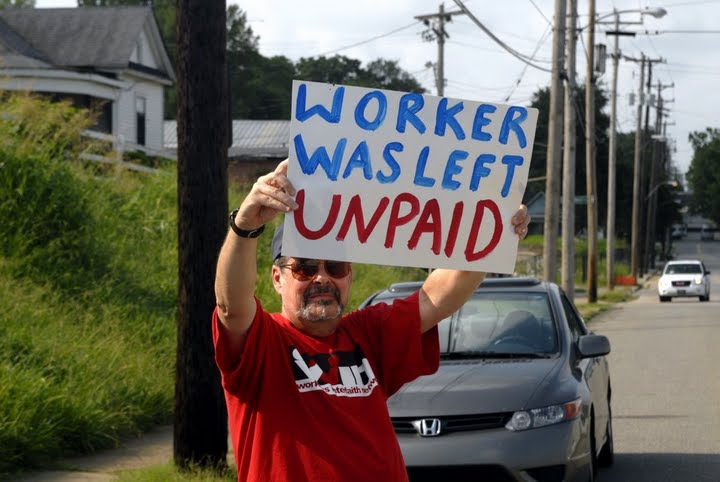
A worker from yet another downtown restaurant is partnering with Workers Interfaith Network to try to win her stolen wages back. Zorina Bowen worked at Safari World Tapas Bar on South Main St. as a cook for three weeks last summer to help out the owner, who was a friend. She was only paid $440 of her wages, and she is still owned $1,493. She was fired when she asked for the rest of her pay. 


As you may have seen on ABC 24's news last week, WIN members joined with Ms. Bowen to picket the restaurant after many attempts to talk with management. A manager came out to belittle Ms. Bowen for not having enough money to hire a lawyer, and refused to talk privately with WIN staff about our records which show how much she is owed.


You can support Ms. Bowen in her struggle for justice by emailing Safari World Tapas Bar and telling them wage theft is unacceptable. Use their website's Contact Us feature to call on Safari manager Faatimah Muhammad to pay Zorina Bowen the entire $1,493 that she is owed for the work she did at the restaurant. Let her know that you will not be visiting Safari until the restaurant follows the law and pays their workers for all hours worked.

Tuesday, June 1, 2010

It Takes a Village to Raise a Social Justice Organization


Parents know what it’s like to see your child one moment and wonder “How did she get so big, so strong, and so smart so suddenly?” As WIN’s founder, I kind of feel that way as we celebrate our 8th anniversary. How did an organization that started with a handful of people and enough donations to last four months become a powerful force for justice in our community?

    Although the exact way things turn out is always a bit of a mystery, what is clear is that you are the ones who have made WIN what is today: you—the active, generous members who have given of your resources and yourselves. God has worked through you to make WIN the place that workers struggling against injustice can turn to.

    Many times, people point to me and the other WIN staff members - Alfredo, Kyle, and James as the reason for our success. And I'll be the first to applaud our staff for their creativity, perseverance, and passion. But the truth is, just like it takes a village to raise a child, it also take a village to raise up a strong social justice organization. 

   So take a moment to celebrate some of the victories you’ve accomplished over the past eight years. And please add your memories, reflections, and hopes for the future - I really want to hear them!
  • June 2002: A handful of religious and labor leaders officially launched WIN this month (originally called the Mid-South Interfaith Network for Economic Justice) so that people of faith would have a chance to take effective action to raise wages and improve working conditions for low-wage workers in Memphis. I started beating the bushes for interested people soon after, which is when I met many of you who showed up at a picket, sent in a donation, or opened your congregation up to learn about our work.
  • September 2003: The Memphis Living Wage Campaign is launched to press the City Council to pay City workers and contracted employees a living wage. Your action, from rallies to prayer vigils to fasting,    result in a city living wage ordinance being passed in 2006, and a county ordinance in 2007, raising the wages of thousands of workers.
  • February 2004: WIN members fill up the buses to Nashville to lobby against a proposed legislature bill that would have banned living wage ordinances in Tennessee cities, as well as any other local laws that raise workers' wages like prevailing wage laws for construction workers. You're successful in defeating it (and you defeated it again in 2009 when a similar bill was introduced).
  • February 2005: WIN joins forces with AFSCME Local 1733 and Grassroots Leadership in successfully rallying against an effort to turn control of Shelby County's Correctional Facility over to a private, for-profit company. 
  • July 2005: Fred’s warehouse workers win their first union contract, raising wages and improving working conditions after years of trying to establish a union. You helped send them to victory through a 40 Day Rolling Fast, picketing at Fred’s stores, and delegations of faith leaders to meet with management. 
  • September 2007: Ready to partner with some of Memphis’ most vulnerable workers experiencing wage theft and other violations of their basic rights, you enable WIN to launch the Memphis Workers’ Center. Today the Workers’ Center has partnered with 42 workers to recover more than $177,000 in stolen wages, workers’ compensation, and discrimination settlements.
  • April 2008: Action by WIN members leads the City Council to raise the wages of City of Memphis temporary workers from $10 an hour to $12 an hour, to make up for their lack of health care benefits.
  • April 2009: The Shelby County Commission passes a prevailing wage ordinance after WIN members join forces with the Memphis Building Trades Council to lobby for its passage. The ordinance ensures that workers on county construction projects are paid sustainable wages, and that the County receives quality work done by trained workers.
What are the significant moments that you think of in WIN's history, that led us where we are today? What lessons can we learn from our past that will help us do our work right now? What is it that drew you to get involved in the worker justice movement through WIN?